Today, we have a digital-first real estate market where every realtor MUST have a seamless online presence. It isn’t optional, it’s essential. But why?
Let’s understand two important terms – Multiple Listing Service or MLS and Internet Data Exchange or IDX. If you are a licensed realtor in Canada or the United States, these terms may ring a bell. They form the backbone of the modern real estate online market. They power the property searches and listings. So, it’s essential to understand these tools, their legal requirements and impact on your business growth and sales.
What Is MLS?
MLS (Multiple Listing Service) is a centralized database of property listings that is shared among all local realtors and brokers. The access is restricted to real estate agents and brokers who are licensed and members of a region’s MLS. An MLS allows agents to:
- Share listings of a wide range of properties in the area.
- It helps agents access accurate and up-to-date information about properties.
- MLS lays down rules for agents collaborating on co-listings and commission splits, allowing for a fair share for all parties.
In the United States and Canada, MLS systems are not mandatory, but they are widely accepted and used strongly by both countries.
What Is IDX?
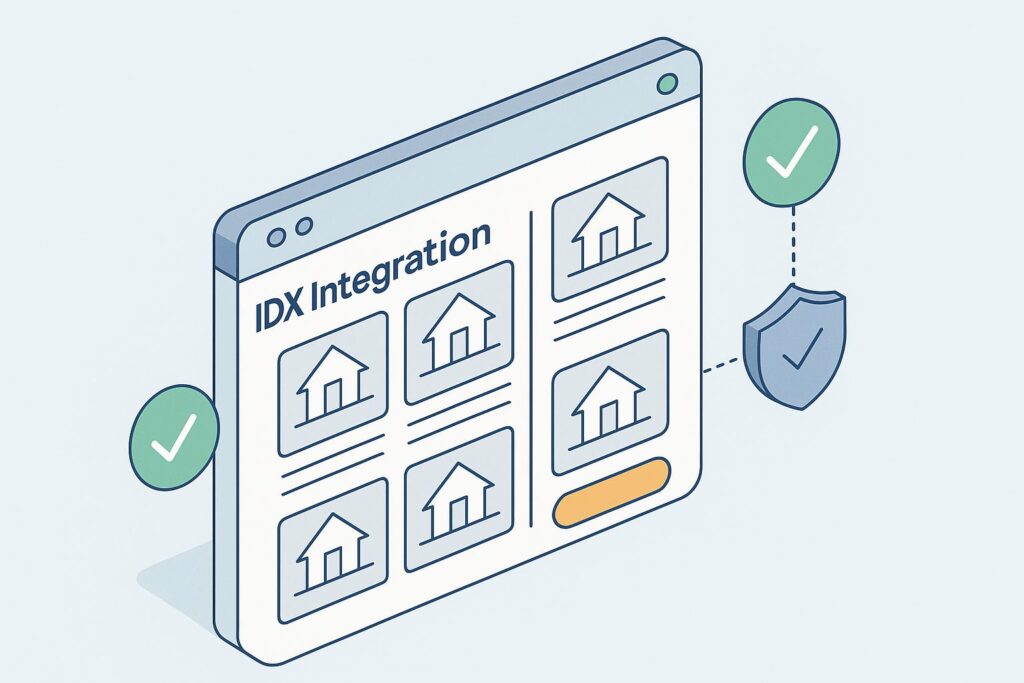
IDX (Internet Data Exchange) is a system or policy framework that gives realtors and brokers an opportunity to legally, and in a controlled manner, present their MLS listings to the public. Since MLS listings are restricted to members only, IDX acts as a legal window giving the public a peek at the authorized data.
IDX benefits realtors by:
- Expanding online exposure and increasing leads.
- Keep all property listings up-to-date using automatic syncing with MLS.
- Enhances the search experience of buyers with a comprehensive and up-to-date property database on the website.
IDX is not a database like the MLS. However, it is a combination of rules, standards and technology that governs how MLS data is displayed to the public.
Key Differences Between MLS and IDX
| FEATURE | MLS | IDX |
| Purpose | Centralized data of properties for agents | Displays MLS listings online to the public |
| Accessibility | Restricted to licensed agents who are members of the MLS | Accessible data via the agent’s online platforms |
| Legal Requirements | Widely accepted and used | It is a standard among MLS members |
| Primary Users | Realtors and brokers | Realtors and their clients |
Step-by-Step Guide To Setting Up Your Real Estate Website
Setting up a real estate website is not a difficult feat when done with the guidance of professionals. With a clearly laid out plan, the right tools and understanding of the target clients, you can get started following a few simple steps.
Define Your Goals
- Decide the priorities of your real estate business. Whether it’s lead generation, better branding or property listing.
- Identify the target client profile: tenants, investors, luxury buyers, first-time buyers, etc.
- Determine the geographic focus – neighborhoods or locations.
- Set financial goals- revenue targets, leads per month, monthly operational costs, etc.
Choose A Domain and Hosting
- Find a domain that is short, memorable and in line with your brand identity. You can choose to make it SEO friendly by using relevant keywords, using a universally recognized extension (.com) and avoiding hyphens.
- Choosing a host will determine whether you retain a buyer or not. Look for the following when choosing a hosting provider for your website:
- Fast loading times.
- SSL certificate
- 99.9% uptime.
- Regular backups.
- 24/7 support
- Compatibility with your website.
Integrate MLS and IDX
- Choose a real estate website builder that offers MLS and IDX integration. It will help you automatically sync your listings and present all real-time information on the website.
- Make sure you comply with all regional legal requirements (if any).
Add Virtual Tours
- Attract your buyers with 3D virtual tours of your properties. They are more engaging, retain buyers and increase chances of conversions. It’s a 3D walkthrough, which is very convenient for people searching for a house online.
- Virtual tours directly or indirectly boost SEO by increasing dwell time, reducing bounce rate and increasing chances of shareability.
Leverage AI And Automation
- Artificial intelligence can be utilized in making recommendations based on search history, suggesting SEO-friendly descriptions, analyzing data and offering insights.
- Automation increases efficiency by handling repetitive tasks. It can deliver chat responses, generate follow-up emails, marketing campaigns and more.
Optimize Your Website For SEO And Mobile
- SEO is a traditional yet useful tool for visibility. Use local SEO to optimize business listings and target them towards local buyers.
- Upgrade your website for mobile users. A mobile-friendly website targets a completely different yet most important client profile – buyers searching homes on smartphones.
How To Choose The Right SaaS Platform For Your Real Estate Business?
Take your time to select the best SaaS solution that offers a complete package. Consider the following when making your decision:
- Ease of Use: The user interface must require minimal technical skills.
- Seamless Integrations: The platform must include essential integrations like MLS, marketing tools, email & text automation, CRM, etc.
- Customizations Offered: The platform should be able to configure the website to your brand with customizations for layouts, colors, search filters, branding, CTA placements, etc.
- Scope of Scalability: It should offer the ability to grow the website with your business.
- Support and Maintenance: Must have a responsive team with 24/7 support and features for regular maintenance.
How QualReal Helps Realtors Go Live In Just 1 Week
QualReal is a SaaS based platform that helps get your real estate business online in one week. It’s simple, fast, convenient and your business growth partner. Here’s how QualReal works:
Ready-to-Use Templates: We offer multiple SEO and mobile-friendly templates, each tailored for real estate professionals.
MLS/IDX Integration: Automatically sync all your professional property data with our built-in MLS/IDX integration.
AI-powered Automation: From lead nurturing and chatbots to personalized suggestions, AI automation makes it easy.
Virtual Tours: Create and embed immersive 3D tours of properties to attract buyers.
From Small Agencies to Enterprises: Scaling Real Estate With QualReal Is Easy
QualReal real estate website builder has something for everyone. Whether you are a small agency, a solo agent or a large enterprise, we can give your business the much-needed tech-forward upgrade.
Small Agencies: Get your business online with minimal investment.
Mid-scale Businesses: Utilize the advanced CRM and marketing tools to increase exposure and monthly lead and revenue targets.
Enterprises: Fully customize your website with full automation, advanced analytics and multi-management tools and more.
QualReal deals with all the behind-the-scenes complex construction work so you can focus on selling properties and growing your business.
Book Your Demo With QualReal Today!
If your real estate business is not online, you are missing out on a major opportunity. Build a real estate online platform and get the much-needed upgrade.
QualReal’s MLS/IDX integration cuts down on manual work and automatically syncs all your data with the website, giving you a quick head start. No delays, no compromises. It’s a turnkey solution that is saving you money, time and labor.
Don’t think twice. Transform your real estate business today! Book a Demo today and go live in just one week.